
The Anatomy of Density: Densify and Expand
Join the Urban Expansion program for its second webinar, “Densify and Expand,” as part of its “Anatomy of Density Series,” which explores the increased importance of urban density and its attributes in cities the world over. In this session, Director of Urban Expansion, Solly Angel, and Research Scholar Patrick Lamson-Hall along with several panelists will discuss the results of their recent study, which analyzes how a sample of 200 cities made room for recent urban growth, and they will discuss implications for the future of densification and expansion.
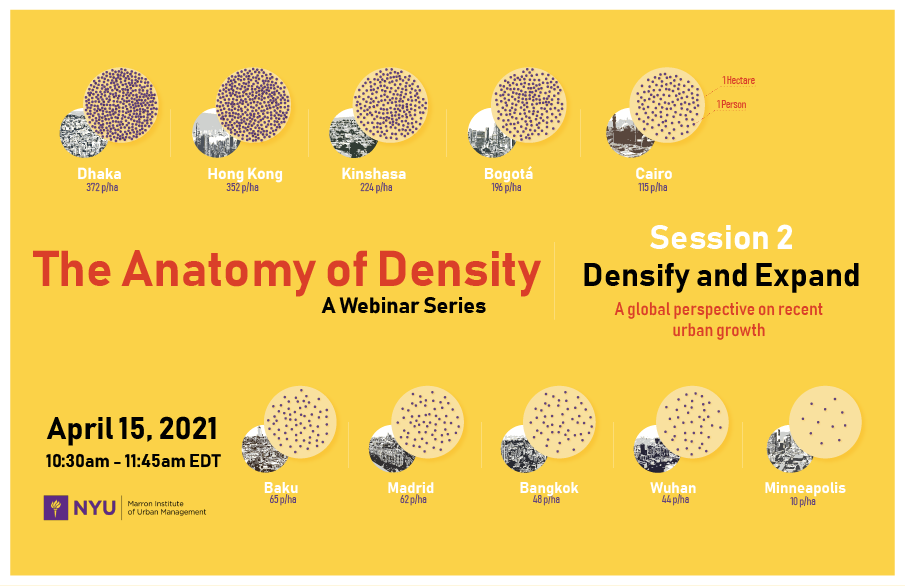
Join the NYU Marron Urban Expansion Program in a series of four webinars to explore the increased importance of urban density and its attributes in cities the world over.
More than ever, urban density is at the fore of discussions of mitigating climate change, managing pandemics, promoting housing affordability and economic development, and protecting the countryside from further encroachment. There are calls for making cities denser, to increase the use of public transit, biking, and walking, and for containing urban expansion to force the densification of existing urban footprints. Yet densities have continued to fall over the past three decades, and densification advocates have little to show for their efforts. It is now urgent to understand how to turn the tide and advance a pragmatic densification agenda for cities the world over. This webinar series provides a new and deeper understanding of urban density and its critical role in shaping the destinies of cities in the decades to come. The series includes:
- Anatomy of Density
- Densification vs. Expansion
- Densification Case Studies
- Densification Strategy for NYC’s Next Mayor
Session 2: Densify and Expand
Serious concerns with accelerating global warming have yielded urgent calls to increase urban densities: Higher densities are associated with lower greenhouse-gas emissions, especially those from motor-vehicle use. In order to densify meaningfully in the coming decades, cities need to make room for more people within their existing footprints. If they can’t, cities need to create more room through outward expansion, typically resulting in lower overall densities. In a recent study, we focused on the population added to a sample of 200 cities, between 1990 and 2014. In three-quarters of the cities, the areas built before 1990 gained population and thus densified significantly. On average, however, only one-quarter of the total added population was accommodated within the 1990 urban footprints, while three-quarters was accommodated in the newly built expansion areas. This resulted in an overall decline in average urban densities, despite the near-global, decades-old, and rarely questioned consensus that urban expansion must be contained. In this webinar, we present the results of our study and discuss implications for the future of densification and expansion.
RSVP for The Anatomy of Density: Densify and Expand (opens in a new tab)